
Key takeaways
- Enterprise AI application development is accelerating, but speed without governance creates production risk.
- Gartner predicts 40% of enterprise apps will feature task-specific AI agents by the end of 2026.
- Deloitte reports that companies with 40% or more AI projects in production are set to double within six months.
- Open platforms provide visibility, extensibility, and long-term control that closed AI systems cannot offer.
- Forrester finds most enterprises are still chasing real AI ROI three years into generative AI adoption.
- Self-hosted platforms support on-premise, VPC, and air-gapped deployment without governance trade-offs.
- RBAC, audit logs, and environment isolation form the architectural foundation for safe AI deployment.
Executive Summary: As 40% of enterprise apps shift to AI agents in 2026, “Guardrails” defined as governance, RBAC, and environment isolation, become the critical bridge between probabilistic AI models and deterministic enterprise requirements. Open-source platforms like ToolJet offer the visibility needed to scale without compliance risk.
AI application development in enterprise environments has moved from experimental to operational, and that shift changes everything. Teams that spent 2023 and 2024 running pilots are now expected to deploy AI-powered systems in production under compliance requirements and at scale.
The challenge is no longer generating AI output but controlling where it runs, who can trigger it, and how it behaves in real workflows. Enterprises require predictable system behavior, even when using probabilistic models.
This guide explains why AI guardrails matter, what risks organizations face without them, and how internal tools platforms enable secure, governed AI deployment.
AI Is Accelerating Development, But Reliability Still Matters
AI generates application logic faster than any team previously could. The speed advantage is real and measurable. But production enterprise systems operate under constraints that AI alone cannot satisfy: uptime SLAs, audit requirements, deterministic outputs, and regulatory accountability.
Did you know? According to PwC’s 2026 AI Predictions, 2026 marks the year enterprises shift from AI experimentation to AI accountability, and the winners will be those who built governance early.
The result is a growing gap between what AI can build and what enterprises can safely deploy. Closing that gap requires more than better models. It requires architectural decisions made before deployment, specifically decisions about access, observability, and control. Speed without that structure creates risk, not velocity.
The Core Tension: Probabilistic AI vs. Deterministic Systems
AI application development in enterprise environments creates tension because AI systems are probabilistic while enterprise systems require deterministic, auditable outcomes. Enterprises need predictable system behavior, so AI variability must be controlled through governance layers and structured execution environments.
- AI outputs vary across identical inputs
- Model behavior shifts with data changes
- Multi-step agents compound uncertainty
- Enterprise systems require consistent execution
- Compliance demands auditability and traceability
“According to Forrester, three years into generative AI, enterprises are still chasing ROI, and unreliable, ungoverned AI deployment is a primary blocker.”
The answer is not to slow down AI adoption. The answer is to build the deterministic wrapper around probabilistic AI: governance layers, permission boundaries, observable workflows, and controlled execution environments that make AI behavior predictable enough for production.
Why Enterprises Need Architectural Guardrails for AI
Guardrails are the engineering infrastructure that makes innovation sustainable. Without them, AI agents risk data breaches and compliance failures.
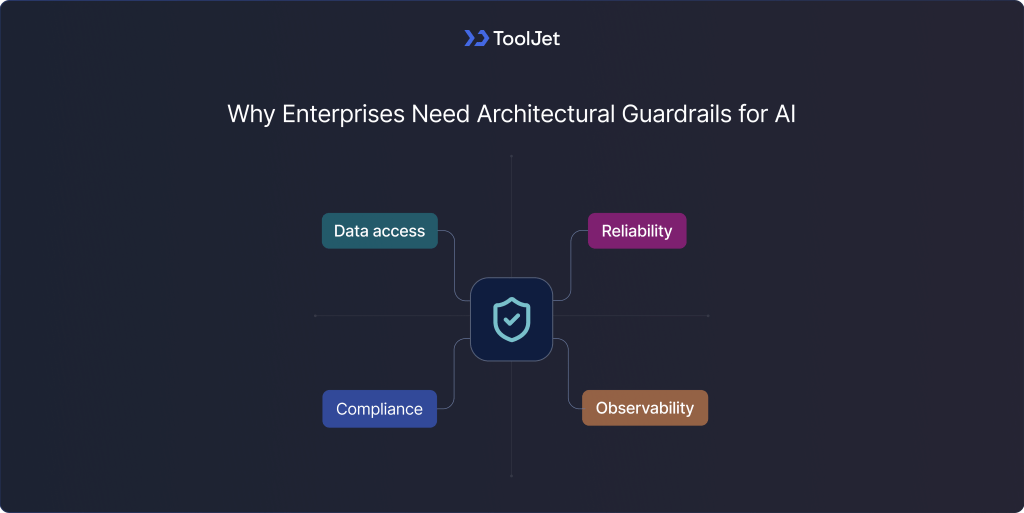
The Four Pillars of AI Guardrails:
- Identity: Granular RBAC scopes agent access.
- Operations: Multi-environment setup isolates live data.
- Auditability: Logs capture every AI action.
- Sovereignty: Self-hosting protects sensitive VPC workloads.
Did you know? KPMG’s AI Pulse report finds that AI governance gaps, not capability gaps, are the primary obstacle to enterprise AI scaling in regulated industries.
Guardrails are not bureaucracy layered on top of innovation. They are the engineering infrastructure that makes innovation sustainable. Organizations that build governance into their AI architecture earlier scale faster because they spend less time recovering from production incidents.
“According to Deloitte, enterprises that establish governance frameworks before scaling AI deployments report significantly fewer production failures and faster time-to-value on subsequent projects.”
Where Internal Tools Platforms Become Critical
AI application development in enterprise environments requires structured systems because AI runs within workflows, data pipelines, and user interfaces.
“According to KPMG’s research on low-code excellence, enterprises using structured internal tools platforms reduce AI integration complexity and improve auditability compared to teams building custom pipelines from scratch.”
Internal tools platforms provide controlled environments that standardize execution, ensuring AI outputs are reliable, auditable, and aligned with enterprise requirements.
- Provide standardized data connectors across systems
- Enforce consistent permission and access models
- Enable reusable workflow logic and automation
- Centralize deployment and environment control
- Improve auditability and system observability
Building AI-powered internal tools on a governed platform standardizes how AI behaves across the organization. Every team uses the same permission model, the same connector framework, and the same deployment pipeline. That standardization is what makes AI observable and controllable at scale.
Deploying AI inside enterprise systems? See how ToolJet’s workflow builder gives AI agents a governed, observable execution environment.
How ToolJet Provides Guardrails for Enterprise AI
ToolJet is an enterprise low-code platform built to give engineering teams full control over how AI-powered applications run in production. Unlike black-box AI tools, ToolJet makes every layer of application logic visible, configurable, and auditable.
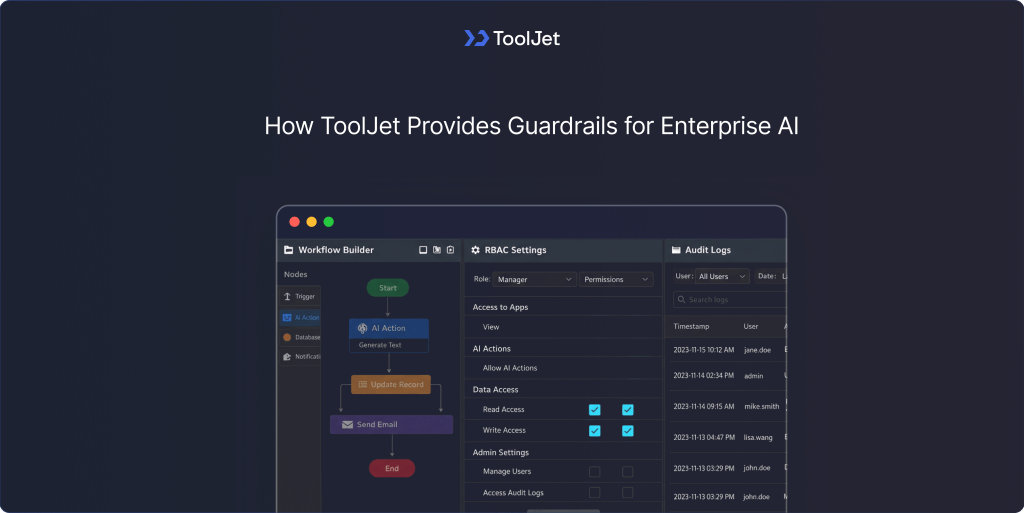
Governance layer:
- Granular RBAC scopes what each user, group, can query, modify, or trigger
- Audit logs capture every action for compliance and forensic review
- Multi-environment setup prevents untested AI logic from reaching live data
Deployment control:
- Self-hosted infrastructure options span Docker, Kubernetes, etc.
- Air-gapped deployment securely houses sensitive AI workloads
- Environment isolation prevents cross-environment data leakage
Transparency and observability:
- Every workflow is visually defined and inspectable
- Git sync keeps application logic versioned
- ToolJet MCP provides a structured protocol layer
“According to TechCrunch’s coverage of ToolJet, the platform’s open-source architecture gives enterprises visibility and control that proprietary alternatives cannot match.”
Open Platforms vs. Black-Box AI Systems
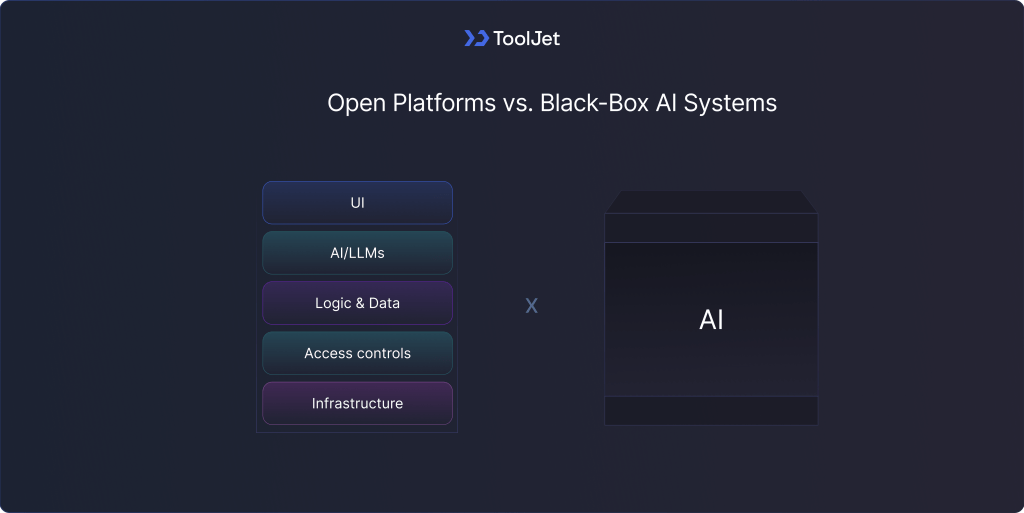
The architectural choice between open and closed platforms determines long-term control over AI behavior. Open platforms expose logic, enable governance policies, and allow full system extensibility, while closed systems trade control for convenience.
| Capability | Open Platforms | Black-Box Systems |
| Visibility | Full logic access | Limited transparency |
| Customization | Flexible workflows | Restricted customization |
| Deployment | Self-hosted via setup guide | Vendor-controlled |
| Compliance | Enforced with audit logs | Limited control |
Where the Difference Matters in Production
- Custom AI permissions via RBAC guide
- Vendor-defined access limits control
- Custom audit schemas using audit logs
- Vendor logs lack compliance flexibility
- SSO integrations via SSO setup
The architectural choice between open and closed platforms determines long-term control over AI behavior. Open platforms expose their logic, allow custom governance policies, and give teams the ability to inspect, modify, and extend every layer of the system. Closed platforms optimize for initial ease-of-use at the cost of that control.
Did you know? Research and Markets projects the enterprise AI market will reach significant scale through 2030, with governance tooling emerging as a primary procurement criterion for regulated industries.
The open-source foundation of ToolJet makes this a concrete advantage, not a theoretical one.
Real Enterprise Use Cases
The guardrail model described above is not theoretical. Teams across industries already deploy AI-powered internal applications with this architecture.
Common use cases include:
- AI-powered support dashboards
- Automated approval workflows
- Internal analytics tools
- Operational monitoring systems
“According to EY, agentic AI deployment in enterprises is accelerating fastest in organizations that pair AI capability with structured governance and human-in-the-loop checkpoints.”
Building AI-powered workflows? Start with ToolJet’s app templates, pre-built governed architectures for common enterprise use cases.
Things to Check When Building with Self-Hosted AI Platforms
Without strong governance and infrastructure maturity, these risks can directly impact compliance, reliability, and production stability.
Here is what self-hosted teams must manage:
- Unauthorized access vulnerabilities
- Excessive AI permissions risk
- Unpatched security exposures
- Data loss from weak backups
- Undetected AI failures
- Compliance and audit gaps
Teams must also ensure proper access controls and visibility across systems, which is why structured approaches like RBAC guide and centralized audit logs are critical for maintaining governance at scale.
For organizations evaluating self-hosted environments, understanding the full deployment guide helps ensure infrastructure is configured securely from the start.
The Future of Enterprise AI Is Governed, Not Just Automated
Organizations that treat governance as a post-deployment concern will spend more time fixing production failures than building new capabilities. As AI adoption grows, governance becomes a core architectural requirement rather than a compliance checkbox.
- Define who can access AI systems
- Control what AI systems can execute
- Monitor workflows for failures
- Enforce auditability across environments
- Standardize deployment across teams
“According to IDC’s FutureScape 2026 Predictions, AI governance will shift from a compliance checkbox to a competitive differentiator, organizations with mature governance frameworks will deploy AI faster and at lower risk than those without.”
The low-code platform market, already projected at $31.59B in 2026 and $78.94B by 2031, is converging with enterprise AI infrastructure. The platforms that win enterprise AI deployments will not be the ones with the most impressive demo.
Why ToolJet Is Built for Governed AI Development
AI application development in enterprise environments requires more than just speed. It requires governance, visibility, and deployment control to ensure reliability.
ToolJet enables organizations to build AI-powered internal tools within controlled environments, combining low-code speed with enterprise-grade governance. Teams can start with a single workflow and scale confidently across systems using ToolJet as their preferred low-code platform.
The enterprises that extract durable value from AI in the next three years are not the ones that moved fastest in pilots. Organizations are increasingly using these platforms to accelerate development and reduce engineering bottlenecks.
They are the ones that built the governance infrastructure to run AI reliably in production, at scale, under compliance requirements. ToolJet provides that infrastructure: open-source codebase, self-hosted flexibility, granular RBAC, full audit logging, and an observable workflow layer that makes AI behavior explainable.
Start building on ToolJet
Give your AI applications the structure they need to survive production.
FAQs
Governed AI deployment layers permission boundaries, audit infrastructure, and observability tooling on top of automation, making every AI action accountable and reversible in multi-user production environments.
Low-code platforms provide the data connectors, workflow logic, and permission layer that give AI a structured, auditable execution environment instead of ungoverned scripts embedded across disparate systems.
Security depends on operational maturity rather than deployment model, and self-hosted teams must fully own IAM configuration, patching, backups, and monitoring to realize the control advantages of running their own infrastructure.
AI guardrails are the governance, observability, and access control layers including role-based permissions, audit logs, and environment isolation that make AI outputs predictable, traceable, and compliant in production.
Enterprise systems require deterministic, auditable outcomes, and without architectural guardrails, probabilistic AI introduces unpredictability and compliance risk that regulated production environments cannot absorb.
Open-source platforms like ToolJet give engineering teams full visibility into application logic and full control over governance policies that closed, vendor-defined systems structurally cannot provide.
ToolJet supports Docker, Kubernetes, AWS, Azure, Google Cloud, and fully air-gapped private networks, with the complete governance stack intact across every deployment target.
The post Application Development in the Enterprise: Why AI Needs Guardrails and Where Open Platforms Fit appeared first on ToolJet.